Marketing for restaurants, auto services and clinics, and for the agencies that run them
On Monday morning, your week is already written.
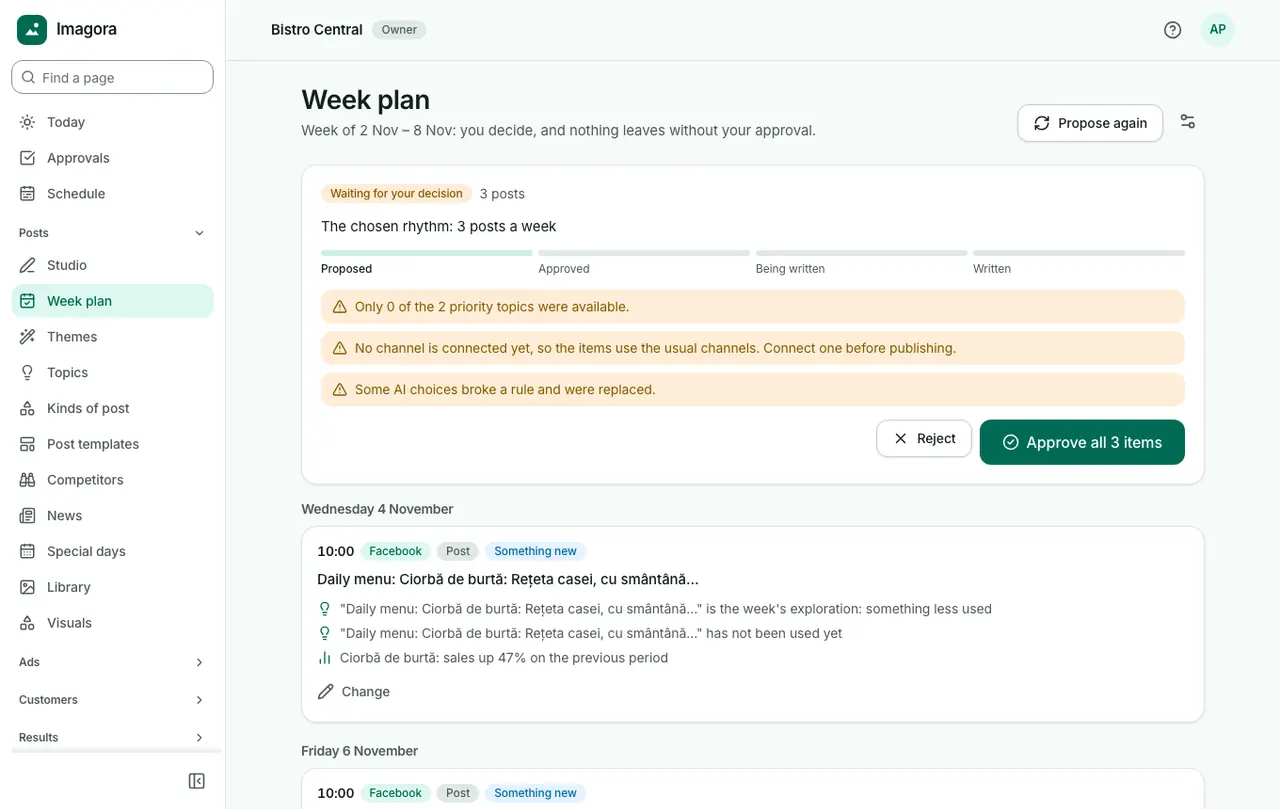
Imagora reads your menu or services, your sales and the calendar, then proposes the week's posts, ads and messages with the images done. You open your phone, see each one exactly as it will appear, and approve or reject it. Nothing goes out until you say so.
What stays with you, and what doesn't
Still yours
- Read the week and approve it, or say no and why.
- Set how much an ad may spend, per day and per month.
- Take a photo when you have something worth showing.
- Call back the people who asked.
No longer yours
- Wondering on Sunday night what to post.
- Writing one offer four times for four channels.
- Waiting for someone to put the price on the picture.
- Paying for ads on a dish you ran out of at noon.
- Finding a form from yesterday that nobody answered.
One week, from start to finish
You set the business up once, or your agency does. After that, this is the whole routine.
All week, and overnight
Your data comes in
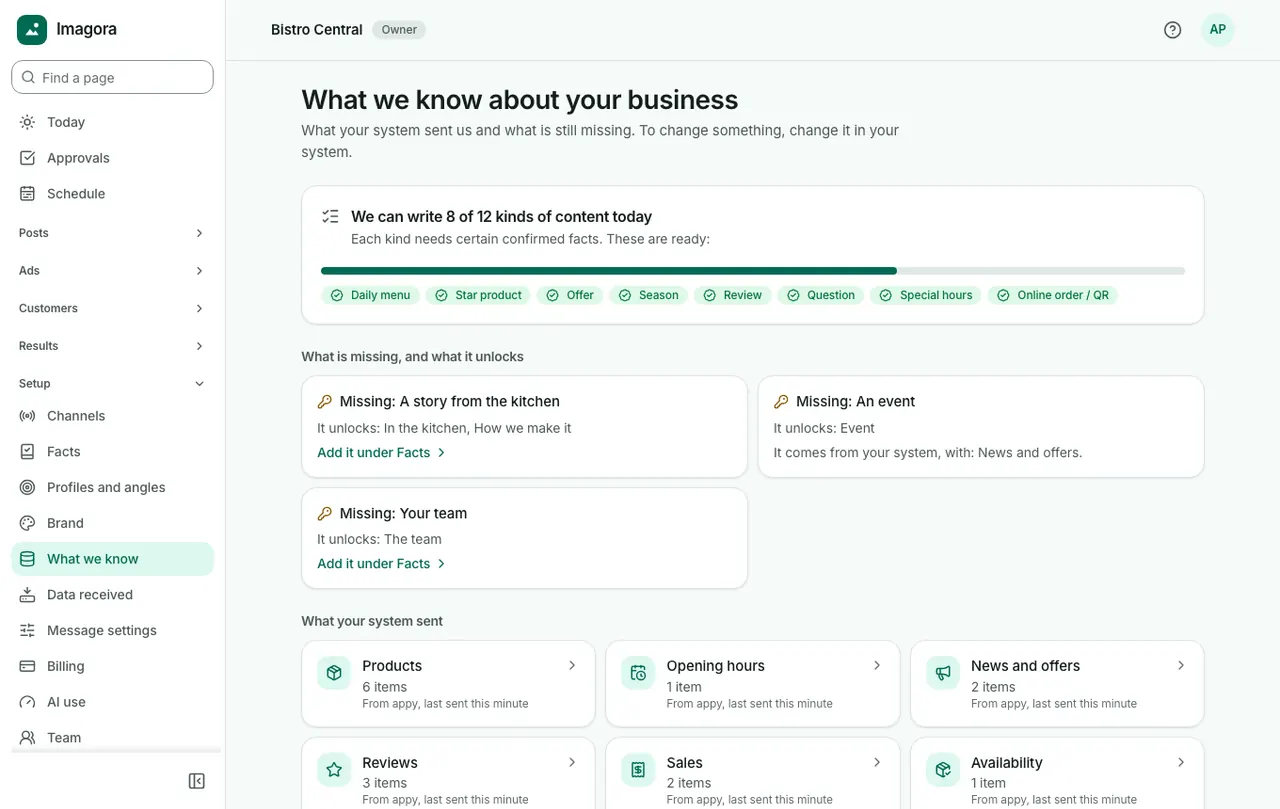
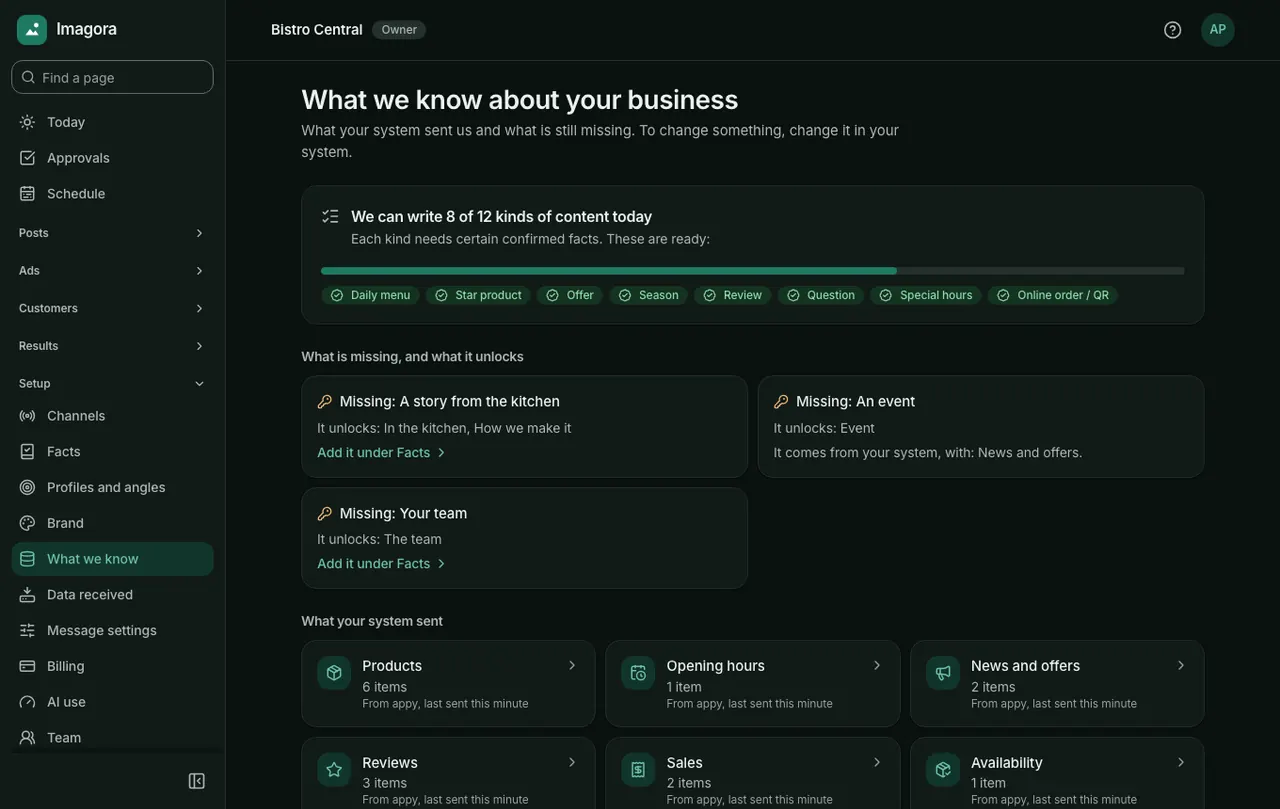
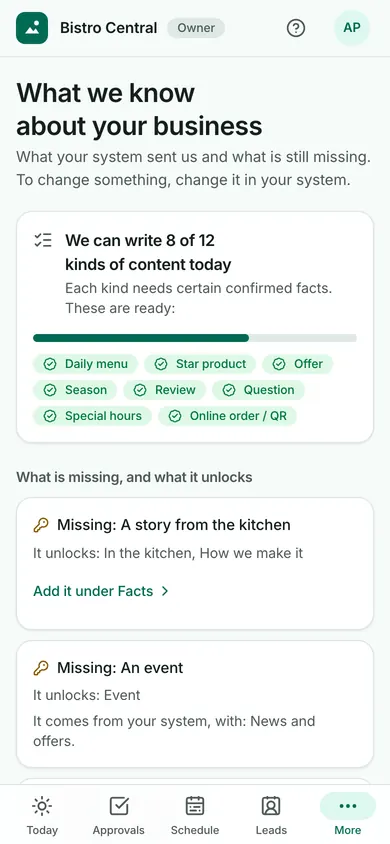
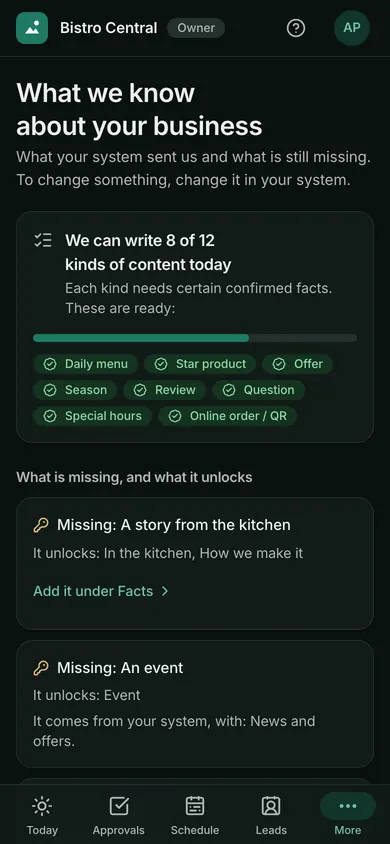
Your system sends products, prices, photos, opening hours, reviews and sales per product and per hour. No system to connect? Import a CSV or type it in. One screen shows what arrived and what is still missing, and what each missing piece would unlock.
Monday morning
The week is proposed
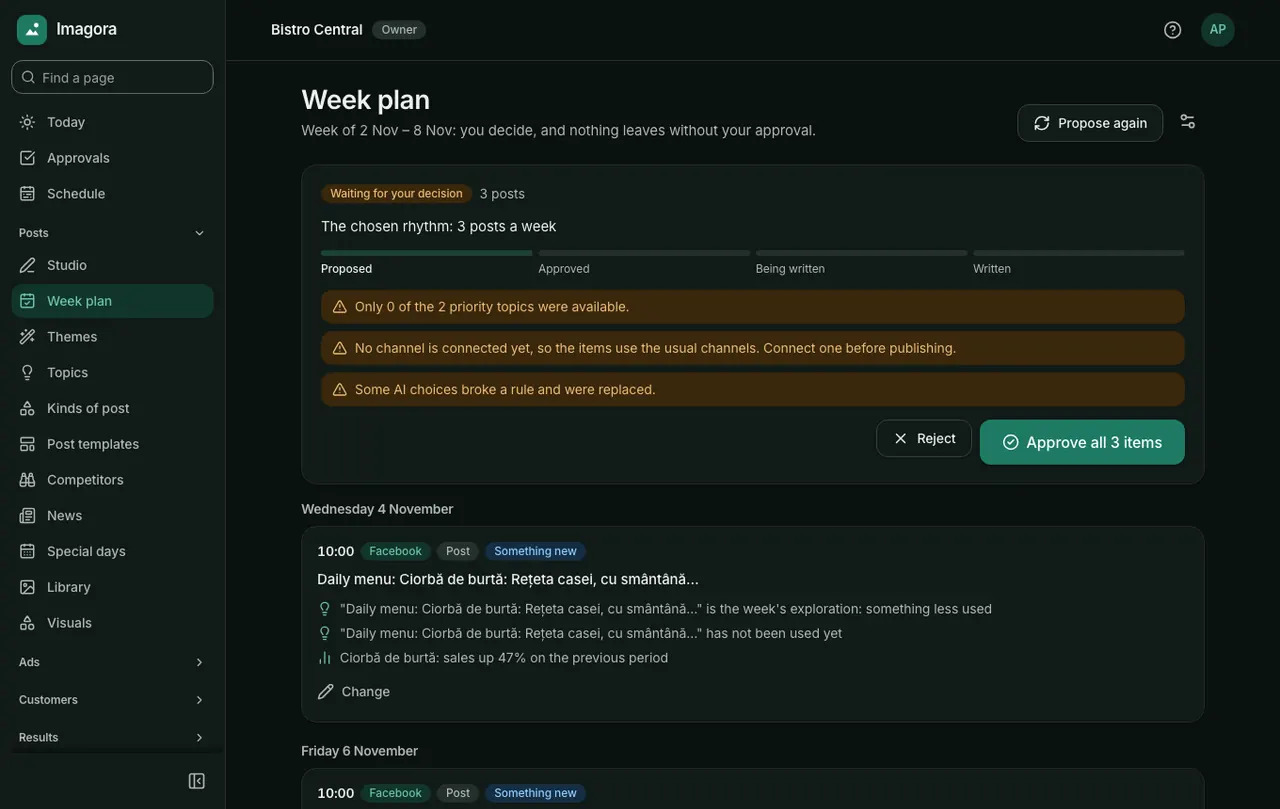
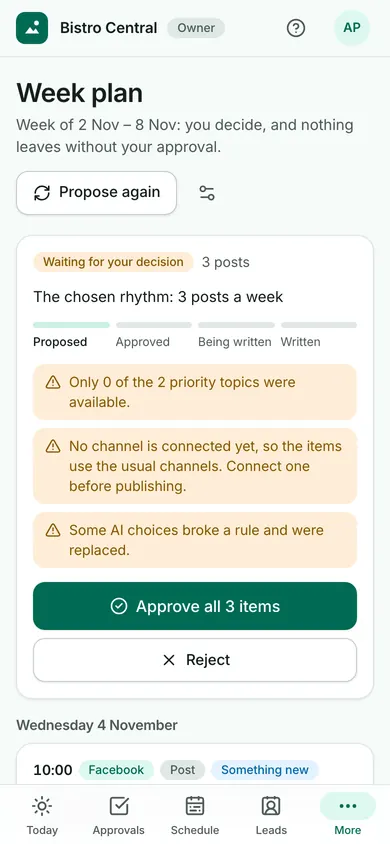
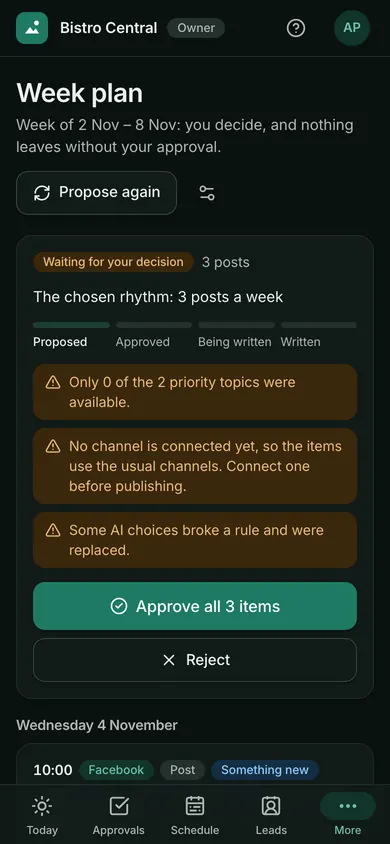
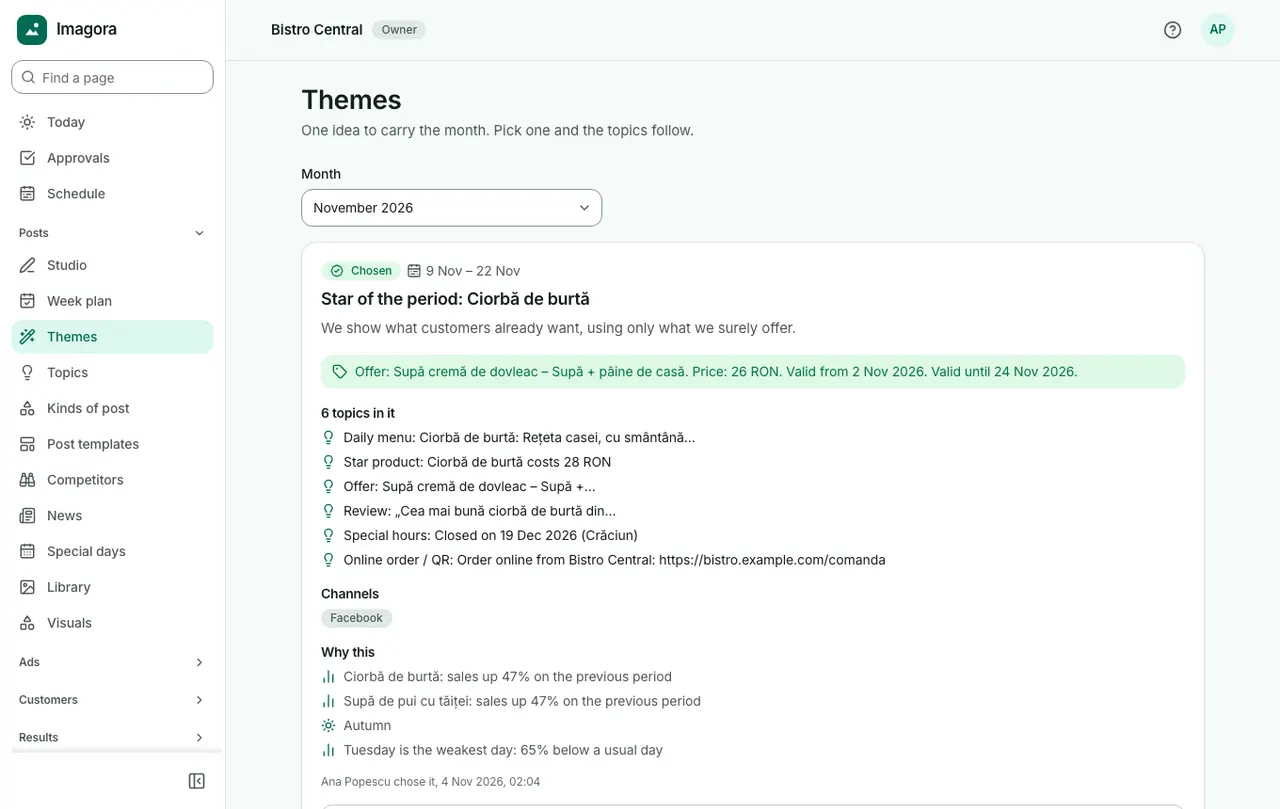
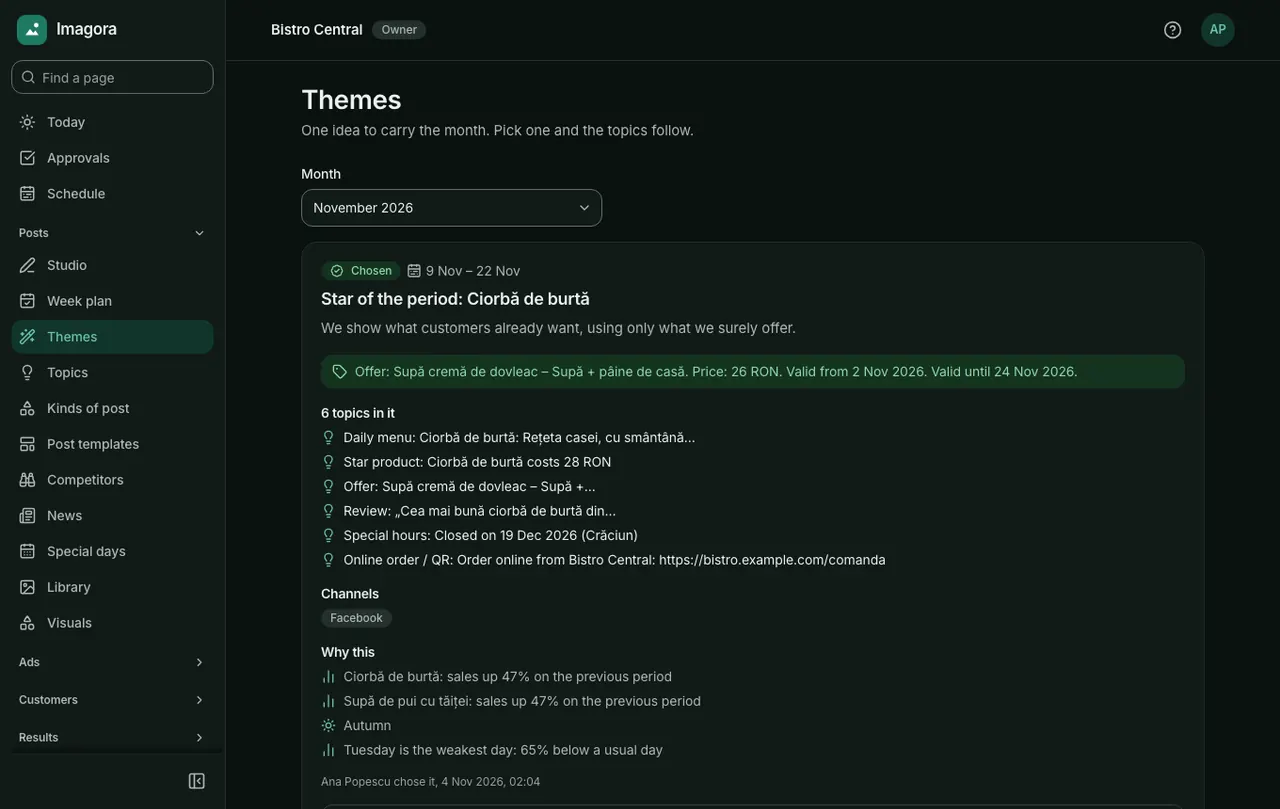
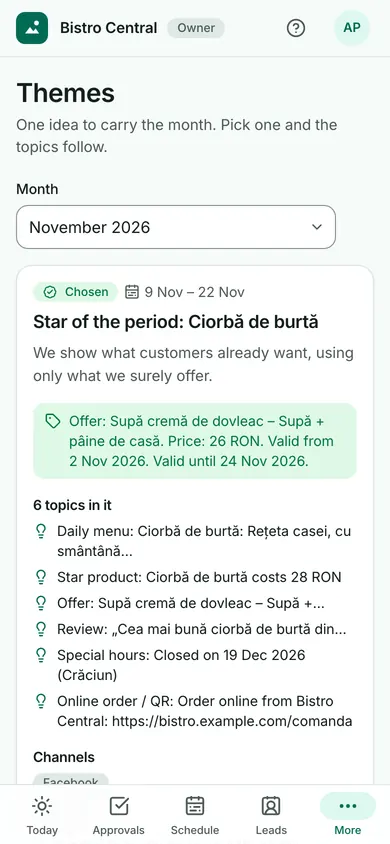
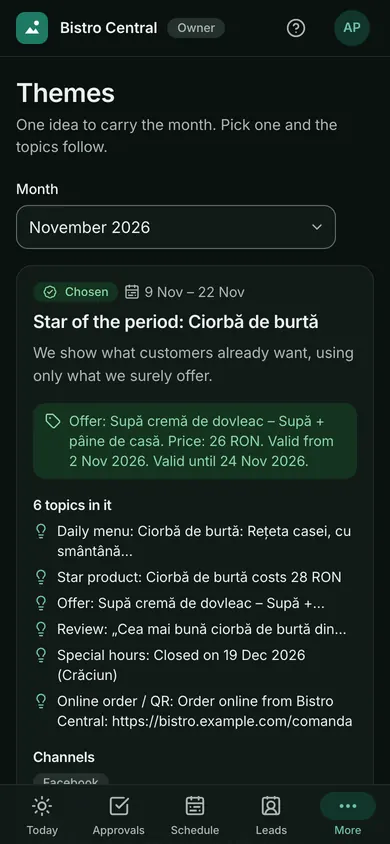
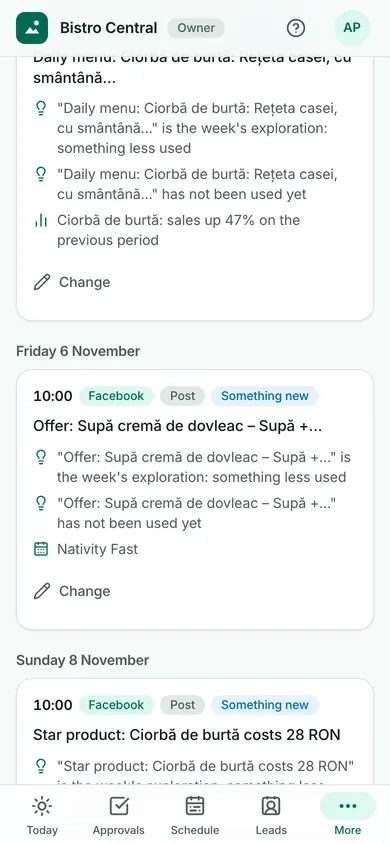
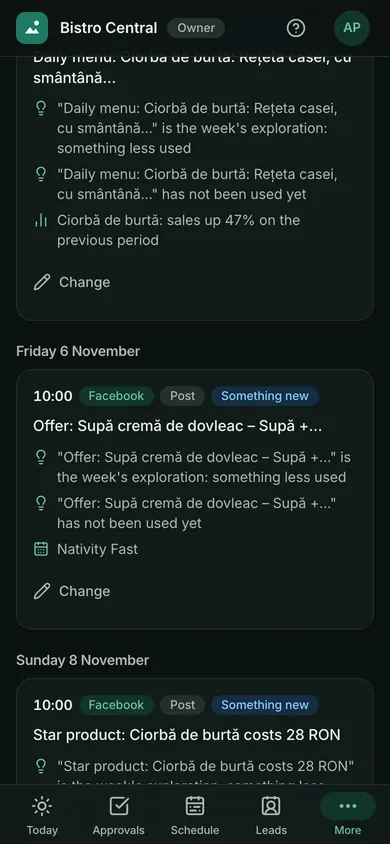
Sales say the soup is climbing. A holiday falls on Thursday. A topic has not run in a while. These become a plan: what goes out, on which day, on which channel, and the reason written next to it. Three themes a month tie posts, ads and emails around one idea with a date on it.
Between two orders
You approve from your phone
A list with the real previews. Approve or reject with one finger, in bulk if you like, and give a reason when you want it done differently. You get a notice by email, Telegram or push when something is waiting. If you never want to log in, a signed link is enough.
At the planned hour
It goes out
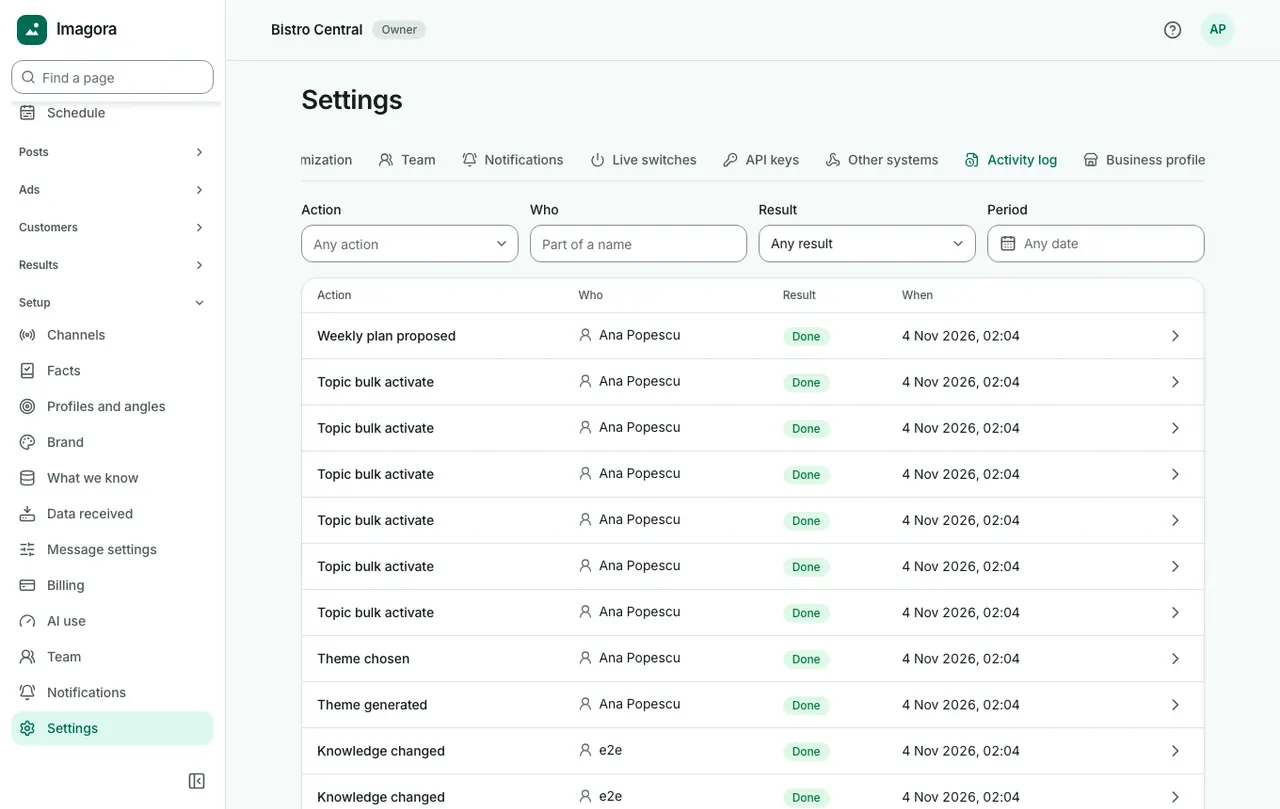
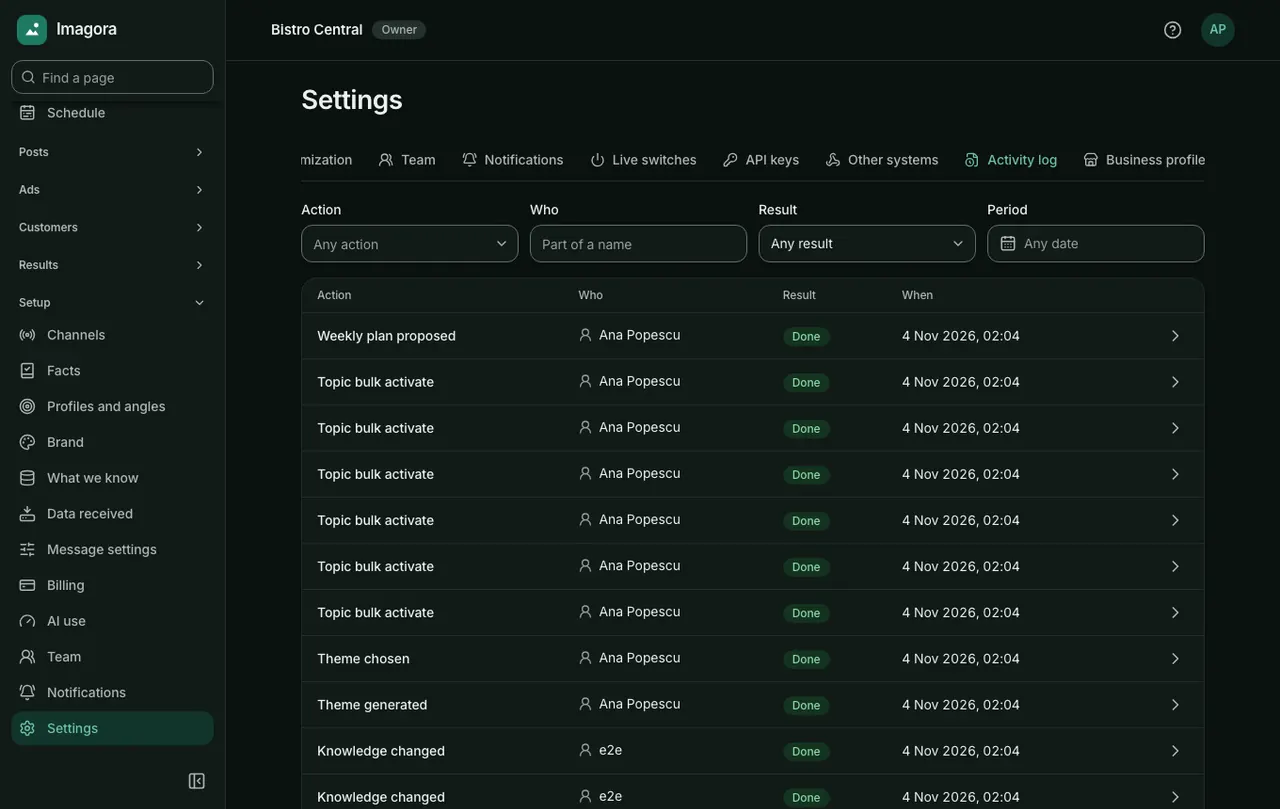
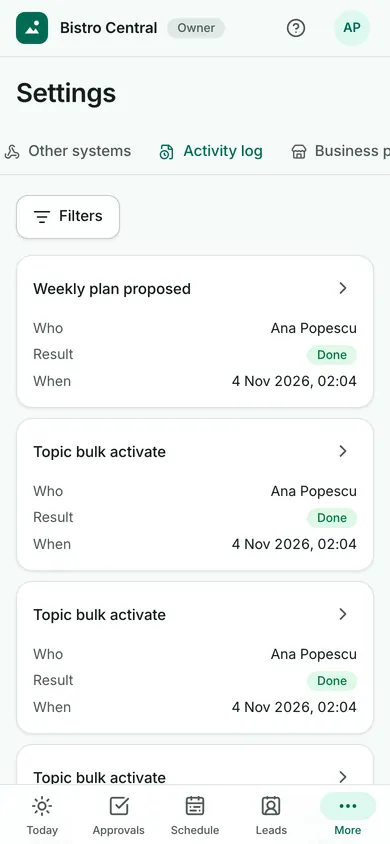
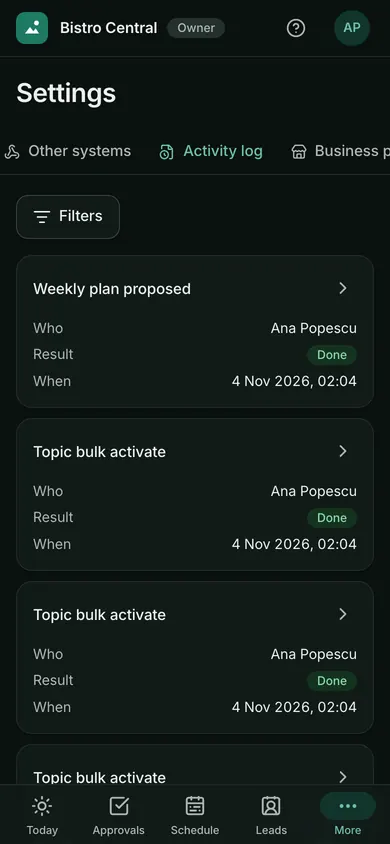
Each post leaves at its hour, with retries if a platform is down and a receipt when it lands. If a platform can't take it directly, you get a card ready to post. Changed your mind? Pull it back. Everything anyone did is in the log: who, what, before and after.
Next Monday
It gets measured
Reach, clicks, leads and customers, per channel, campaign, topic and first sentence, with the cost per customer. The Monday report goes to each business, and to the agency across all of them. What worked feeds the next proposal, and the topic bank remembers what ran, when and how it did.
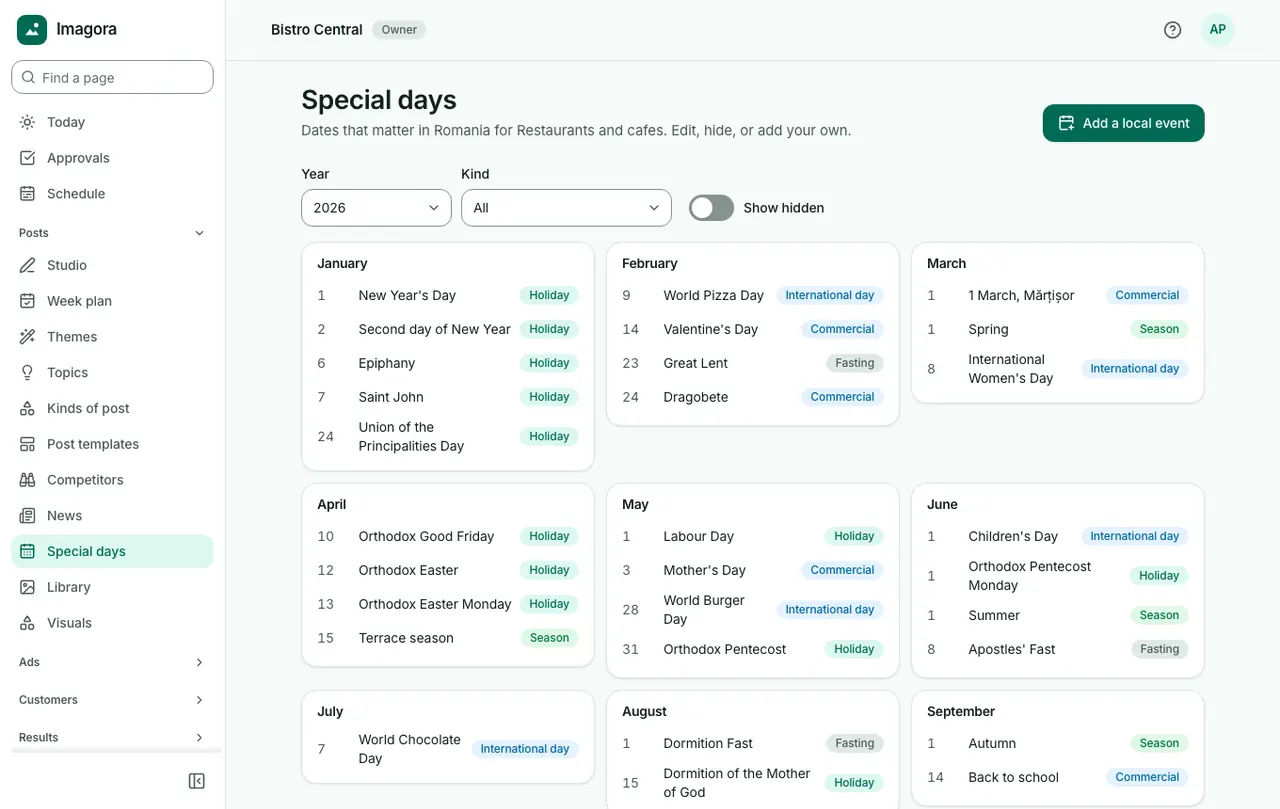
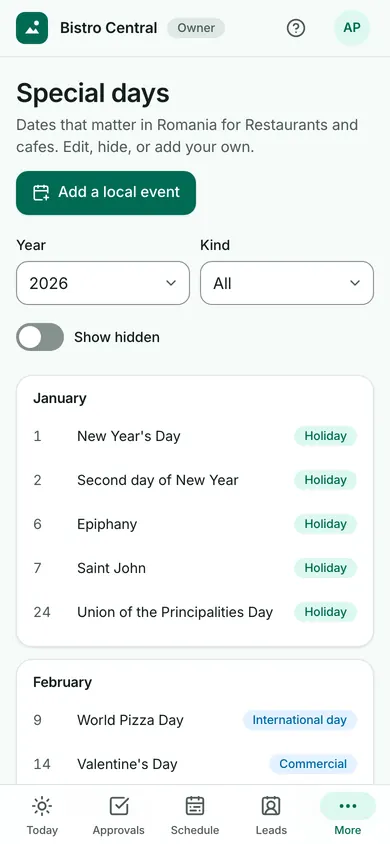
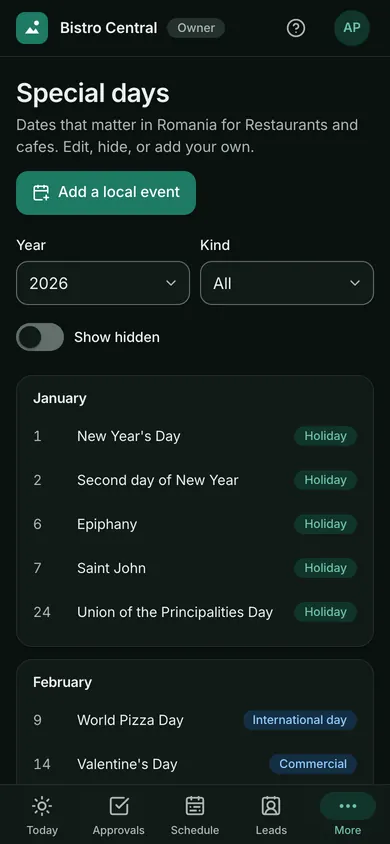
It already knows the calendar
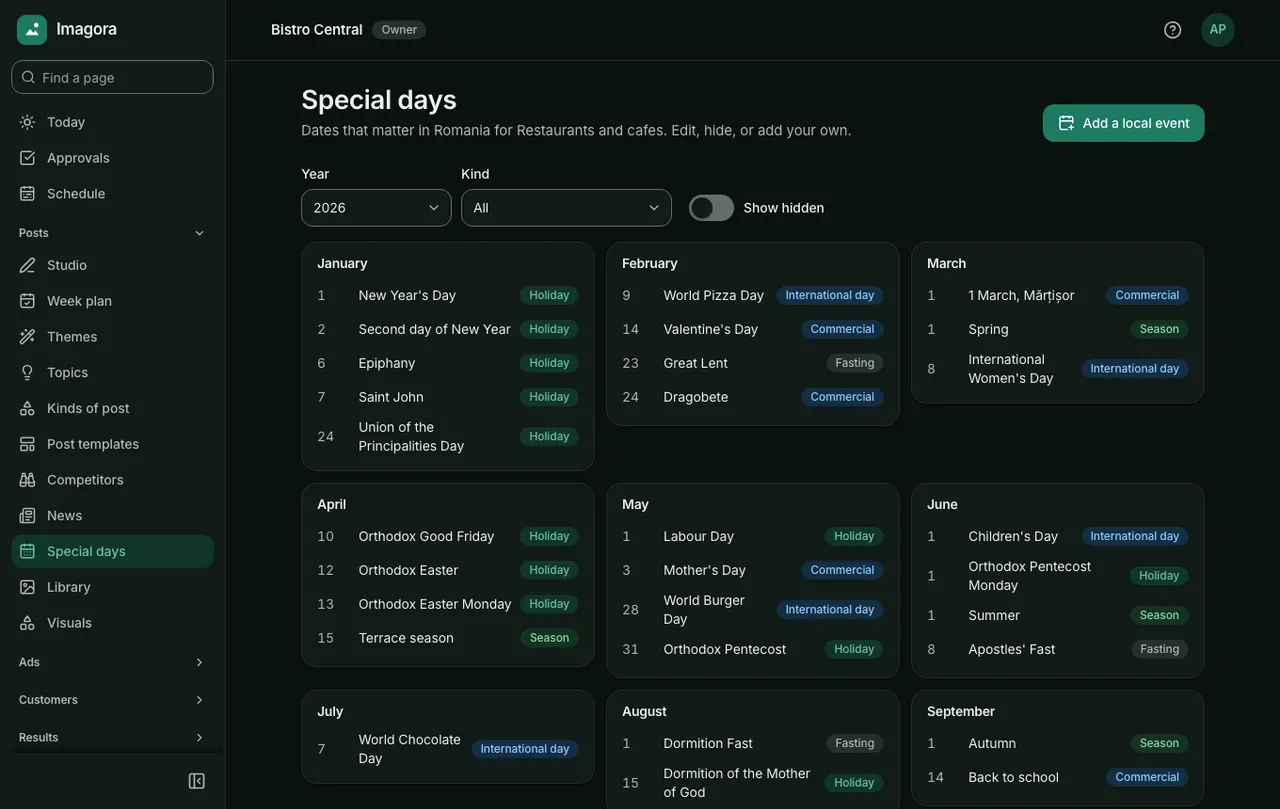
National holidays and seasons for Romania, Bulgaria and Hungary, international days, the winter tyre change, the annual inspection, and the preparation days before each of them. It comes filled in, and you edit it. Add what is local: the town fair, the match, your anniversary.
What you approve is what goes out.
Instagram feed, Story and Reel, Facebook, TikTok, LinkedIn, Telegram, the Google ad, the Google Business post, the email in an inbox, SMS and WhatsApp as a bubble. The caption stops at "more" exactly where the platform cuts it, so you see what a customer sees.
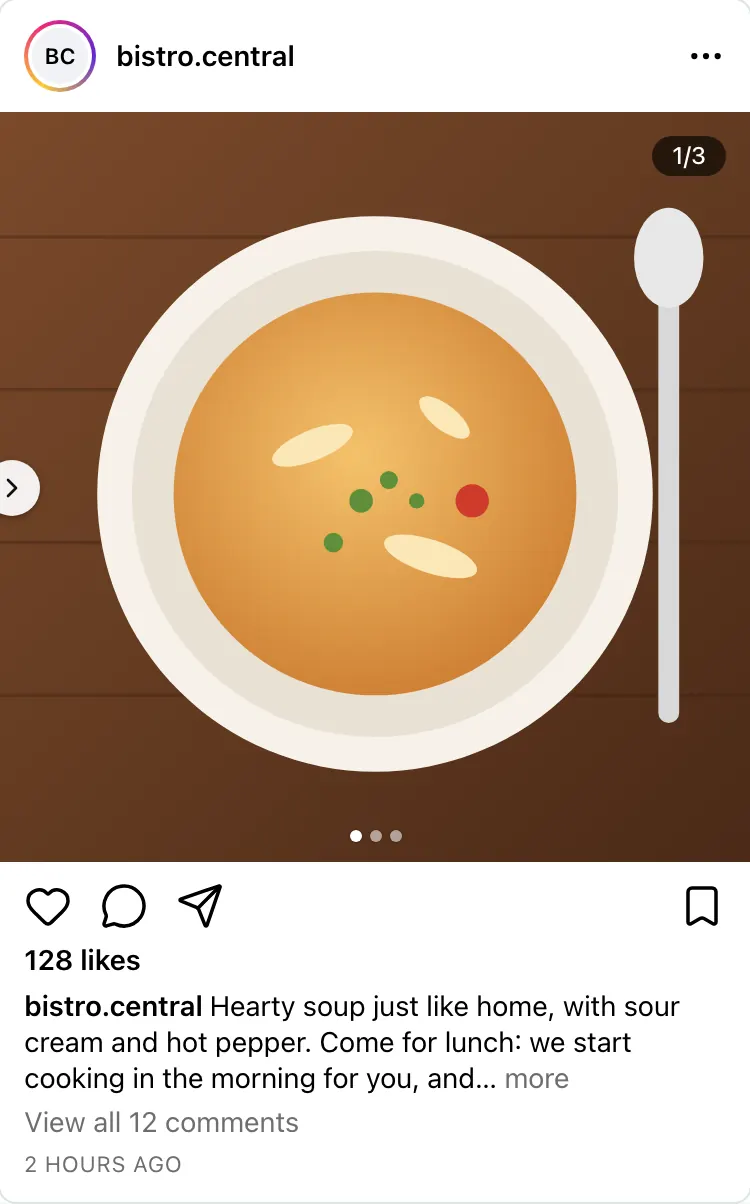

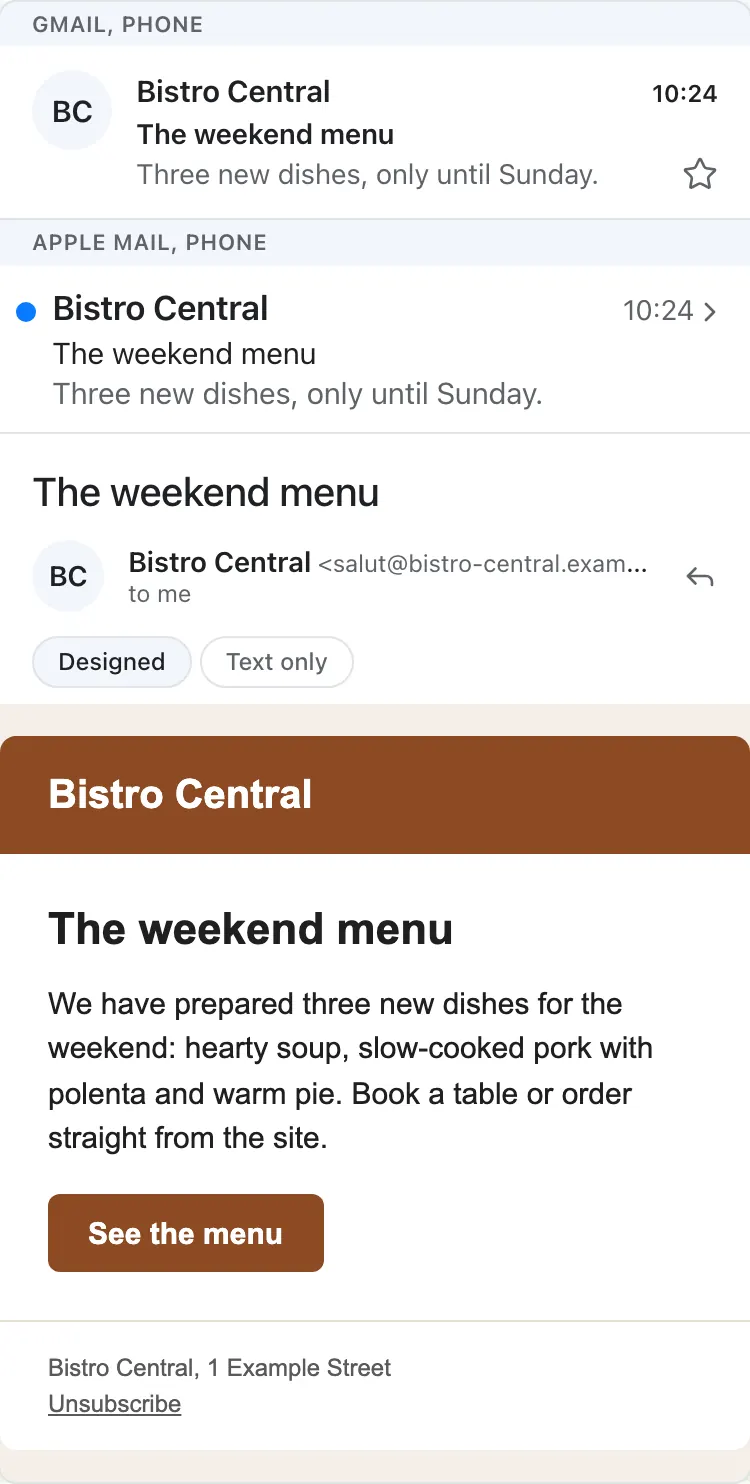
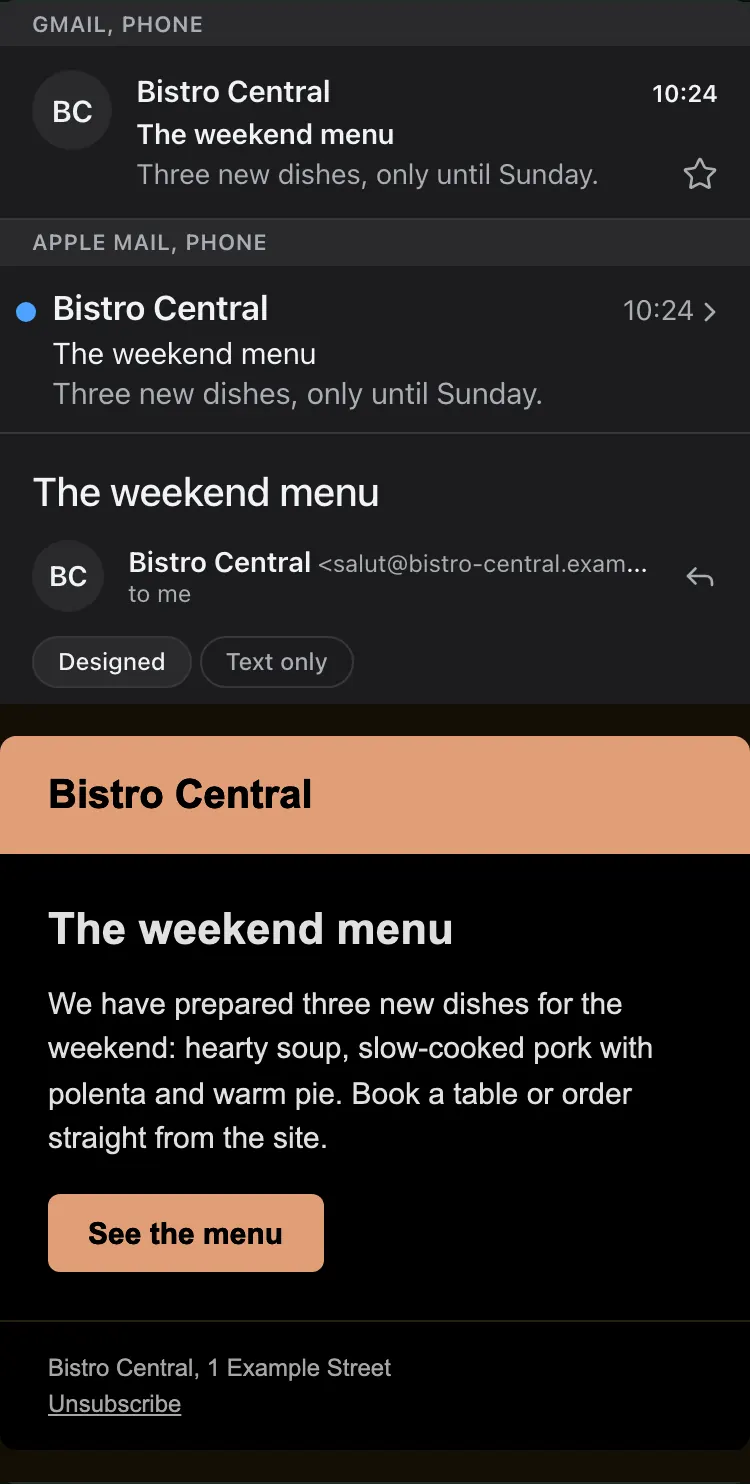
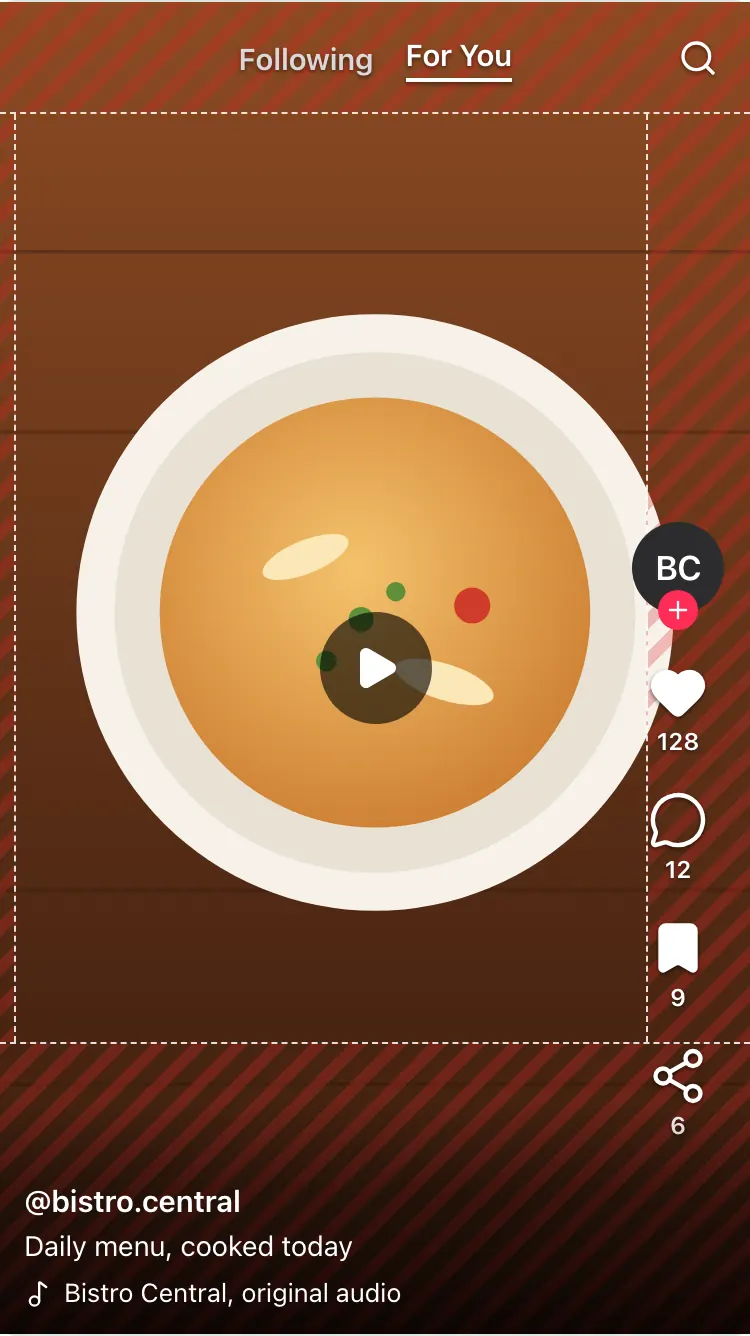
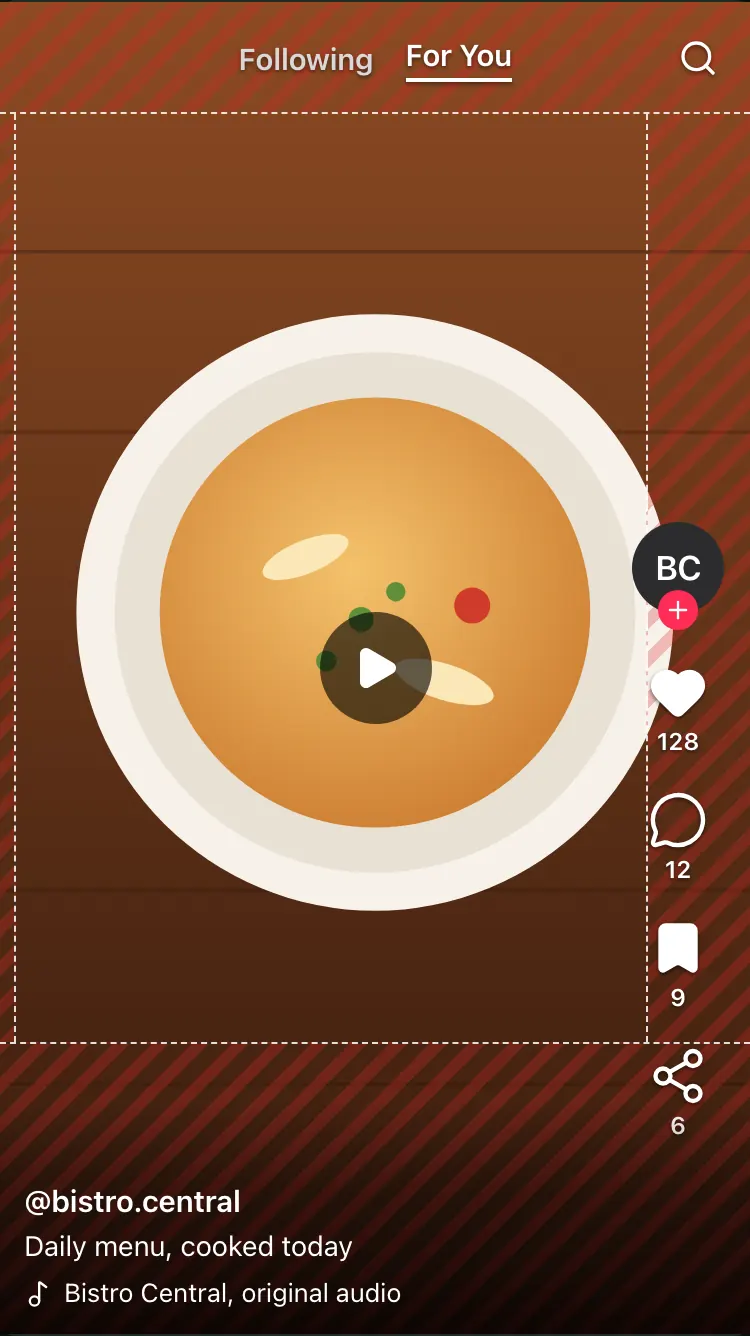
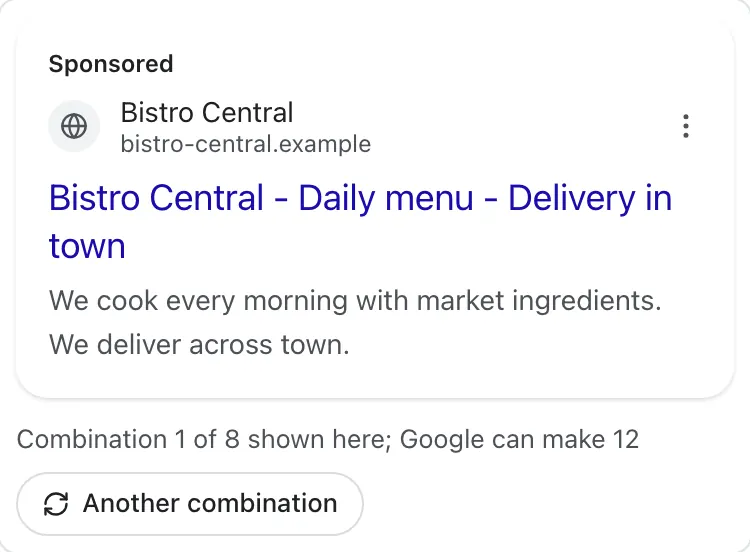
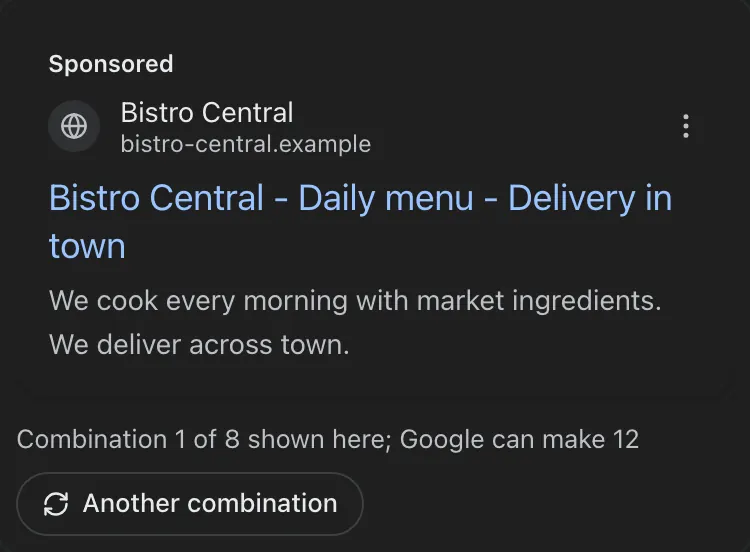
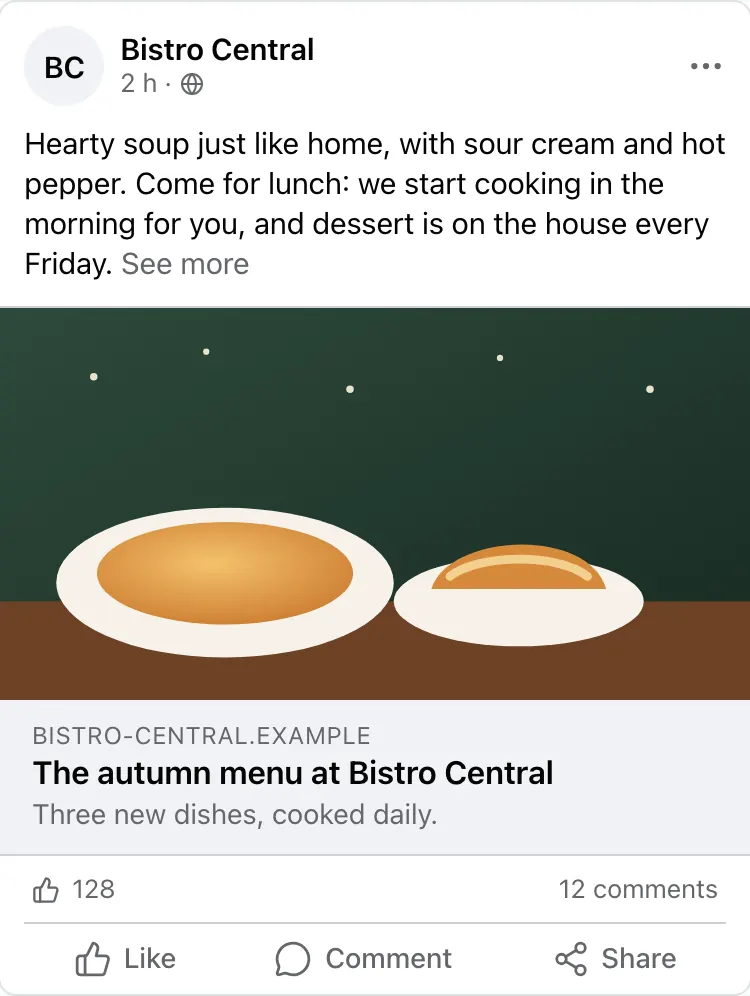
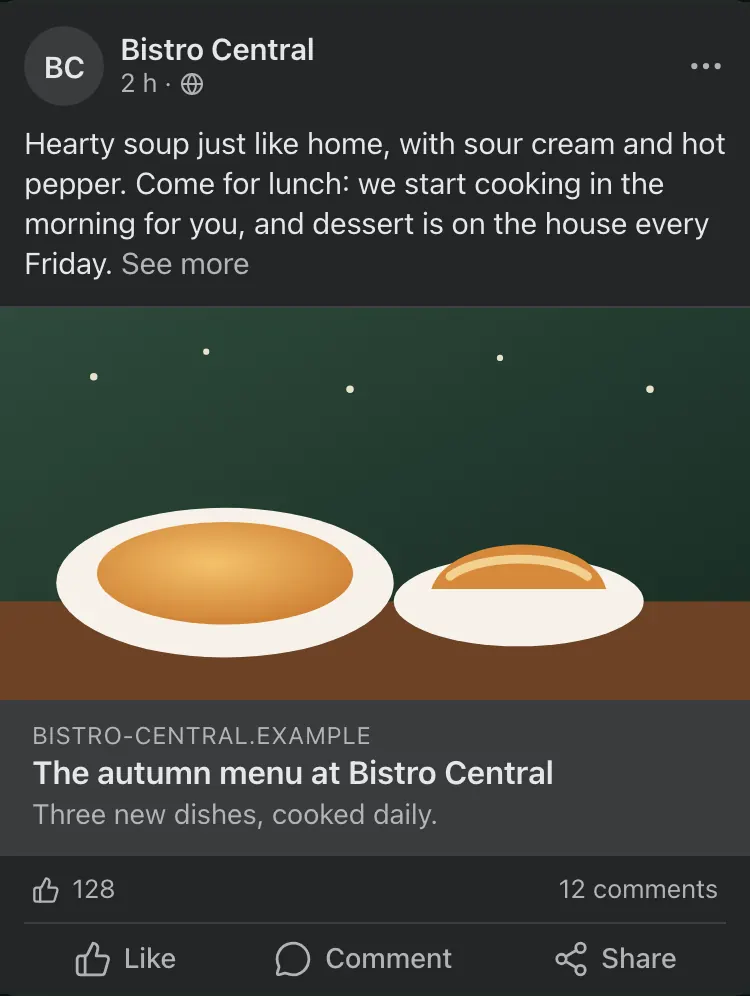
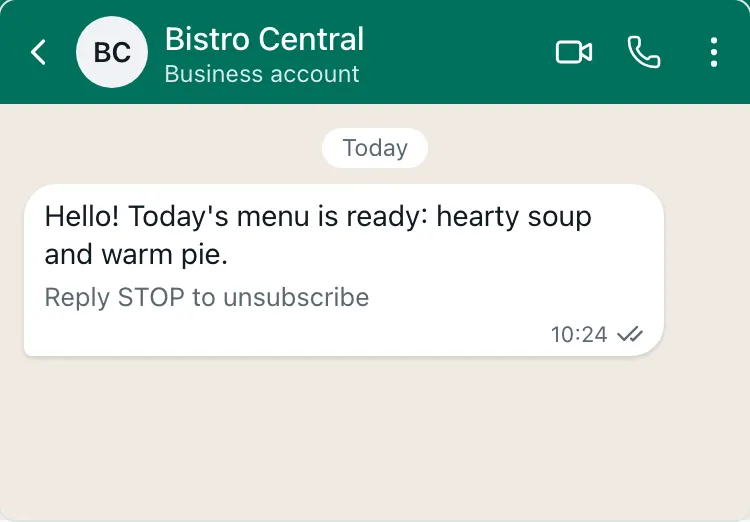
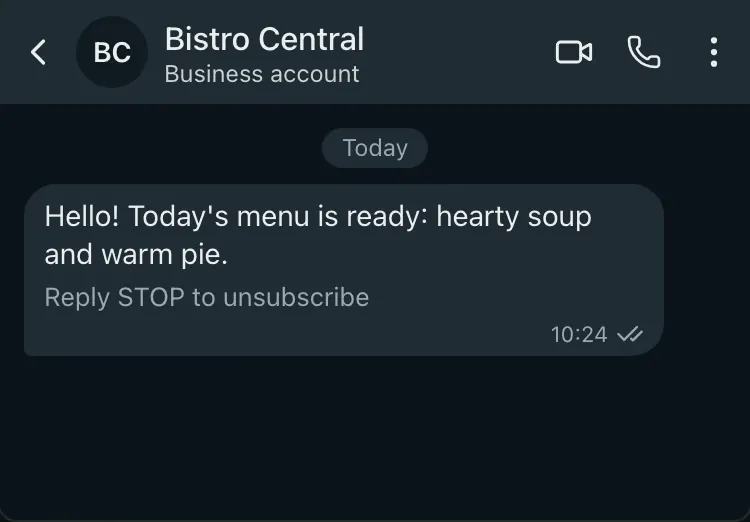


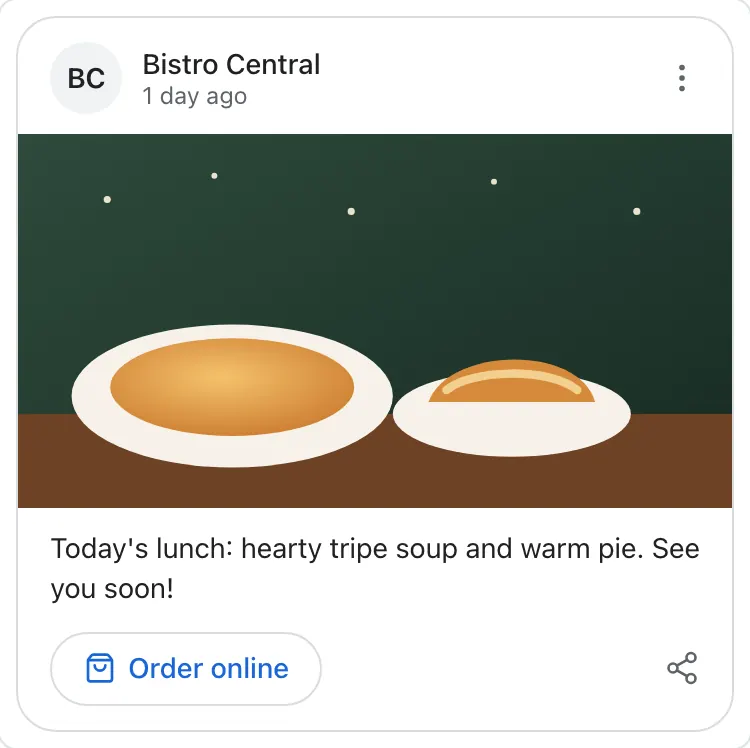
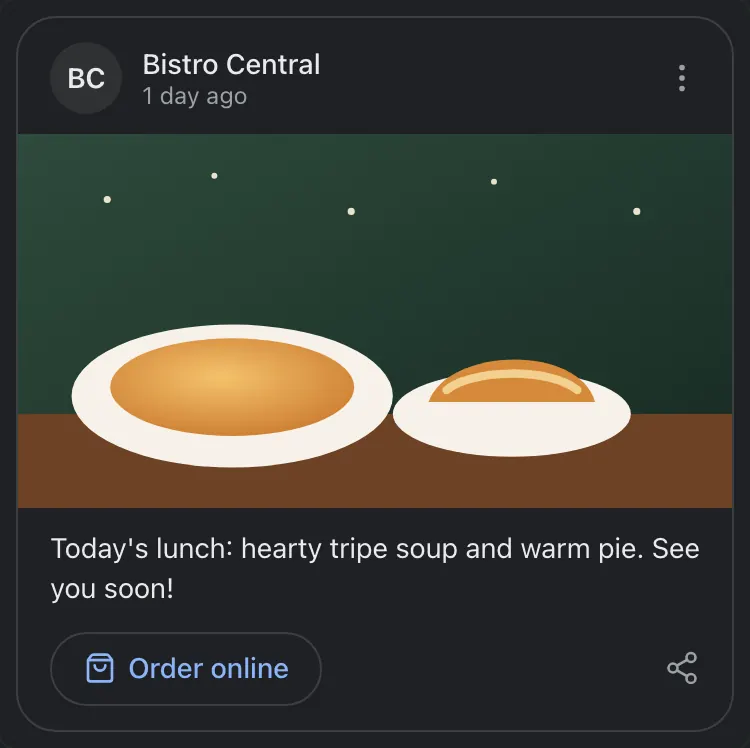
These are the preview components from the product, with sample content.
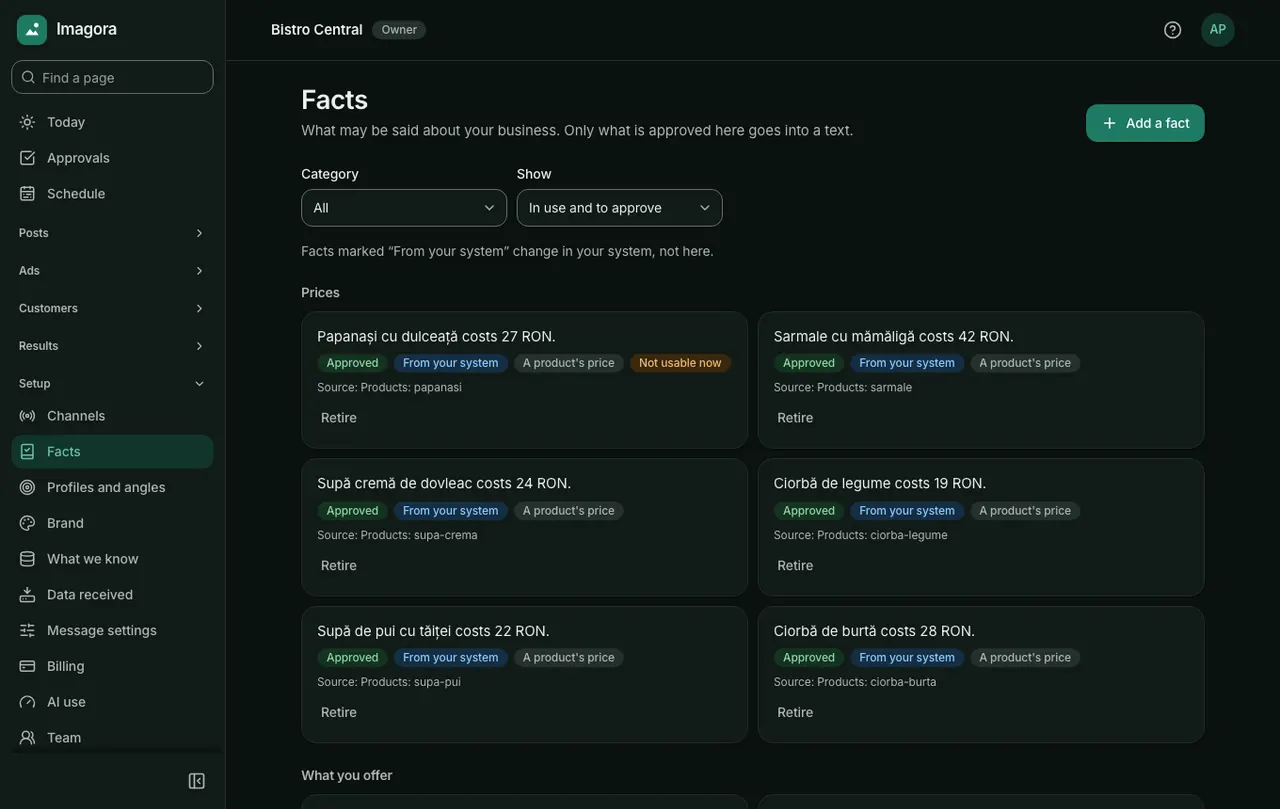
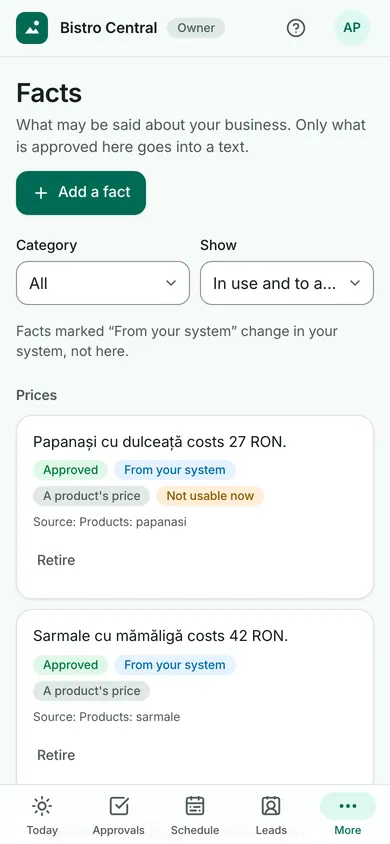
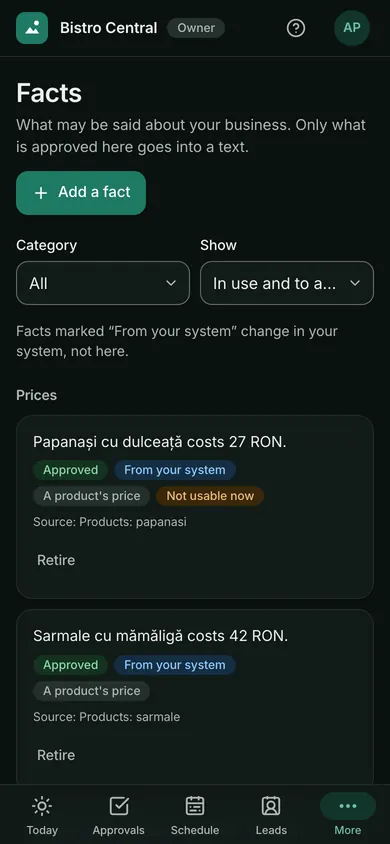
It won't make up a price
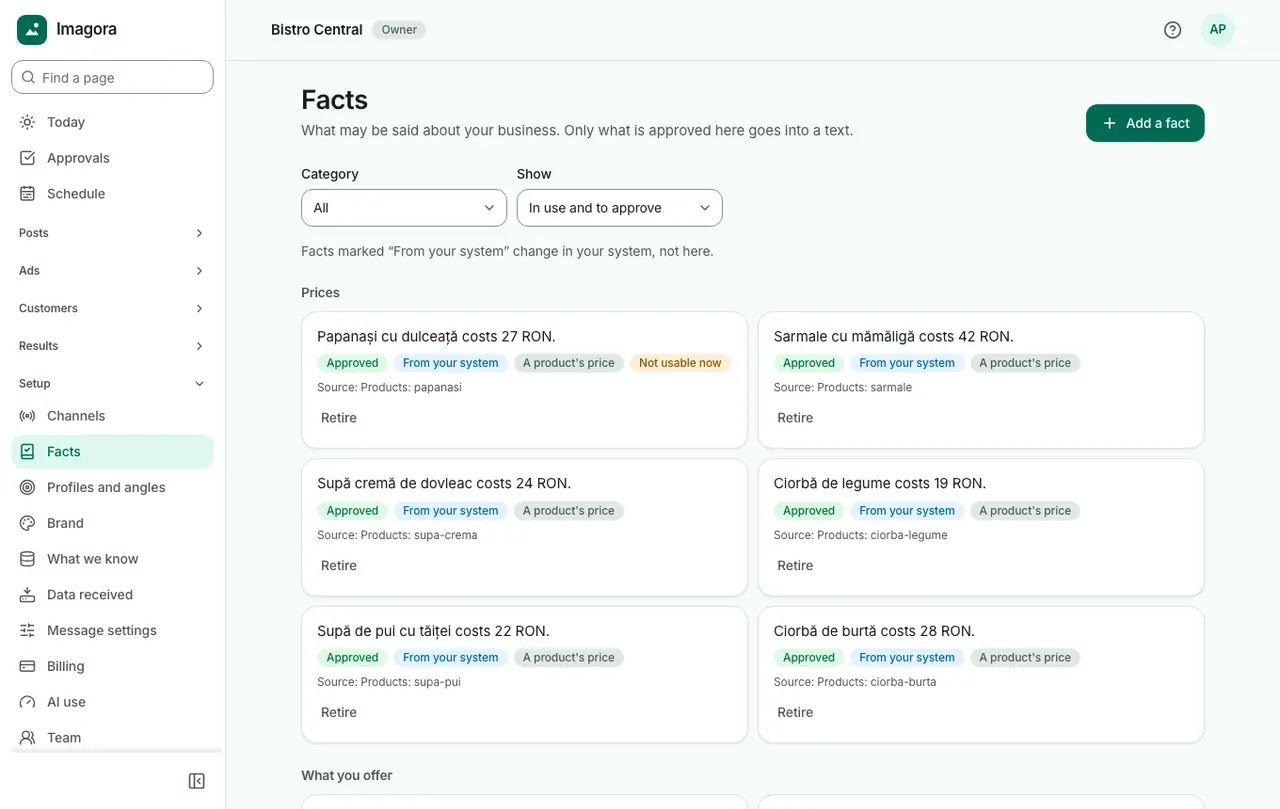
Only facts you approved can go into a text, each with its source and its expiry date. Before you see anything, it has been checked: length per platform, diacritics, every figure against your facts, text cut off or sitting over the image, the safe area of a vertical video, the rules for your country and trade. A second AI model, separate from the one that wrote, judges the result. A red check blocks approval.
Your photos come first
One product photo becomes three visuals: background removed or changed, the price and text in your colours, a QR code to your order page, your logo, in square, 4:5 and 9:16. Carousels and vertical slideshows with burned-in subtitles come from the same photos. AI illustrations are checked by a vision model before they are saved, and your own photos always take precedence.
Where it goes
Some platforms have to approve the connection first. Where that is still pending, the post reaches you as a finished card to publish, or your agency publishes it. Nothing else in your week changes.
| Channel | How it goes out |
|---|---|
| Telegram | Directly, through a bot added to your channel. |
| Facebook, Instagram | Directly once Meta has approved the connection, including Reels. Until then, a finished card or your agency's own Page access. |
| Google Business Profile | Directly once Google has granted access. Until then, a finished card. |
| To your company page, once LinkedIn has approved the connection. Until then, a finished card. | |
| TikTok | To your TikTok drafts, for you to finish in the app. Direct posting follows TikTok's audit. |
| Campaigns and automatic journeys from your own authenticated domain, with double opt-in, weekly limits and a suppression list. | |
| SMS, WhatsApp, Viber | Automatic replies, sequences and campaigns, only to people who agreed on that channel. |
Order status and appointment confirmations stay in your own system. Imagora sends marketing only, and only with recorded consent.
A form filled in at 21:40 gets an answer at 21:40.
Someone asks about a booking or a quote while you are closing up. The circuit runs without you, and the lead lands with the person who should call back.
First minute
An automatic reply by email, SMS or WhatsApp, written from your facts, and an alert to the person responsible.
When time runs out
A second alert if nobody has answered within the time you set for that person.
That evening
A digest of the day: who came in and who is still waiting.
After that
Reminders, a follow-up sequence, a booking link tied to Google Calendar, and one-click unsubscribe.
Every lead shows the ad, campaign and first sentence that brought it. Duplicates merge by email and phone. You name the stages: a table booked at a restaurant, a quote accepted at a garage, an appointment at a clinic, a paying client at an agency.
Ads with a ceiling you set
Promote in your area: pick a dish or an offer, a radius in kilometres, a small budget and a duration. Imagora makes the creative, the preview and the estimate, then leaves the campaign paused until you press start.
The guards
- A ceiling per day and per month, with an automatic pause when it is reached.
- A limit on how much a budget can grow in one day.
- Spend nobody can explain raises its own alert.
- An emergency stop, and a log with before and after for each change.
- A product marked unavailable stops its own ads.
Testing without guessing
Two to five versions of one angle run with equal budgets. The loser is stopped, the winner grows inside the guards, and the next version starts from the first sentence that won. Each decision is explained in the log.
Ads run in your own Meta and Google accounts, and the budget is paid to them, not to us. Managing campaigns from here depends on each network's approval of our access. Until it comes through, an agency works through the accounts it already manages.
One order, counted once.
The pixel sees the visit, the basket and the checkout. Your system knows the order was paid. Both reports carry the same id, so Meta and Google keep one, and the number in their dashboard reconciles with your till.
Purchaseorder-1042Purchaseorder-1042order-1042The click is kept for 90 days
An order twelve days later goes to the ad that brought it, not to "direct".
Phone and till orders count too
If the customer gave a phone or email and agreed, the order is matched in hashed form and reported as a phone or in-store sale.
No consent, nothing leaves
Without consent nothing goes to Meta or Google. The conversion stays in Imagora, marked as such, and your funnel still works from anonymous events.
Clinics report less, on purpose
For medical businesses the event says "appointment made". Never the specialty, the service or a diagnosis.
Your customer list, with only the people who agreed
A customer without proven marketing consent is not kept. They are counted, so you can see how many of your customers agreed, and nothing else. Withdrawing consent suppresses the contact, and deleting them in your system follows through here.
Segments that come ready
- Haven't ordered in 30 days
- New customers
- The best 10%
- Annual inspection due within 30 days
Proposals with the reason attached
Each day Imagora looks at sales, availability and segments, and proposes campaigns with the figures written beside them, taken only from the data you sent. Accept one and it becomes a draft, switched off. Nothing starts by itself, and every budget passes through the guards.
What it looks like in your trade
Restaurants
Tuesdays are slow and the lentil soup isn't moving, so the plan has a Tuesday lunch offer. A dish runs out and its ads stop. Thirty days after someone's last order, a win-back message goes out if they agreed to hear from you. After an order, a request for a review. Your stamp card can run from here too, with your own system handing out the stamp.
Auto services
Annual inspection due in 30 days, the next service, the tyre season: each one becomes a reminder and a post with a date. "Getting the car ready for winter" runs across posts, ads and email for weeks. A quote request gets its answer while the car is still on the lift, and the stage you watch is the quote accepted.
Clinics
Medical advertising rules for Romania and Bulgaria are built in, and regulated content never passes without a person. No patient list enters Imagora. Forms don't ask for free text about symptoms. Ad networks hear only that an appointment was made.
Agencies
Set brand templates and rules once and give them to all your locations. Each owner approves from a phone through a link, with no login to teach. Monday's report covers the whole portfolio. You pay per location you run, and the product can carry your name, colours and domain.
Pricing
29–59 EUR
a month, per location
Topics and themes, images from your photos, approval on the phone, ads in your area and messages to your customers. We confirm the exact figure for your locations before you start.
Agencies pay the same subscription, per location they run, from their own account.
Billed separately
- AI use
- Measured per call, with a monthly ceiling per business, 20 USD by default, and an alert at 80%. A restaurant's week with three posts, two themes and the checks costs about 1–2 USD.
- SMS
- About 0.04 EUR per message. Viber and WhatsApp cost less.
- Ad budget
- Paid by you directly to Meta and Google, in your own accounts.
Payment by card through Stripe. Stripe calculates VAT and gives you a portal to change or cancel the subscription.
Questions owners ask
Do I have to write anything?
No. You can change any text before approving it, or reject it with a reason. What you do have to give, once, is the facts about the business, and most of those come from your system.
Can something go out without me seeing it?
Only if you allow it. Per type of content you choose: only a person approves, the agent pre-checks, or the agent approves within a daily limit with spot checks. It stops by itself if rejections pile up. Medical content always goes through a person.
Do I need a POS or an ordering system?
No. A connected system sends the data by itself. Without one, you import a CSV of products, customers and sales, with a step to match the columns, or you type them in.
Does it post directly to Instagram and Facebook?
Direct publishing depends on Meta approving the connection. Until that is in place for your account, you get a card with the text and image ready to post, or your agency publishes it. The approval and the preview work the same way.
Which languages does it write in?
Romanian, Bulgarian, Hungarian and English, in the app and in the content, with a check on diacritics.
Who sees my customers' data?
Each business has its own workspace, separated in the database itself, and tests try to read across workspaces on every build. Ad networks get only hashed identifiers, and only with consent. Marketing data is kept for 24 months and erased on request.
How do I stop everything quickly?
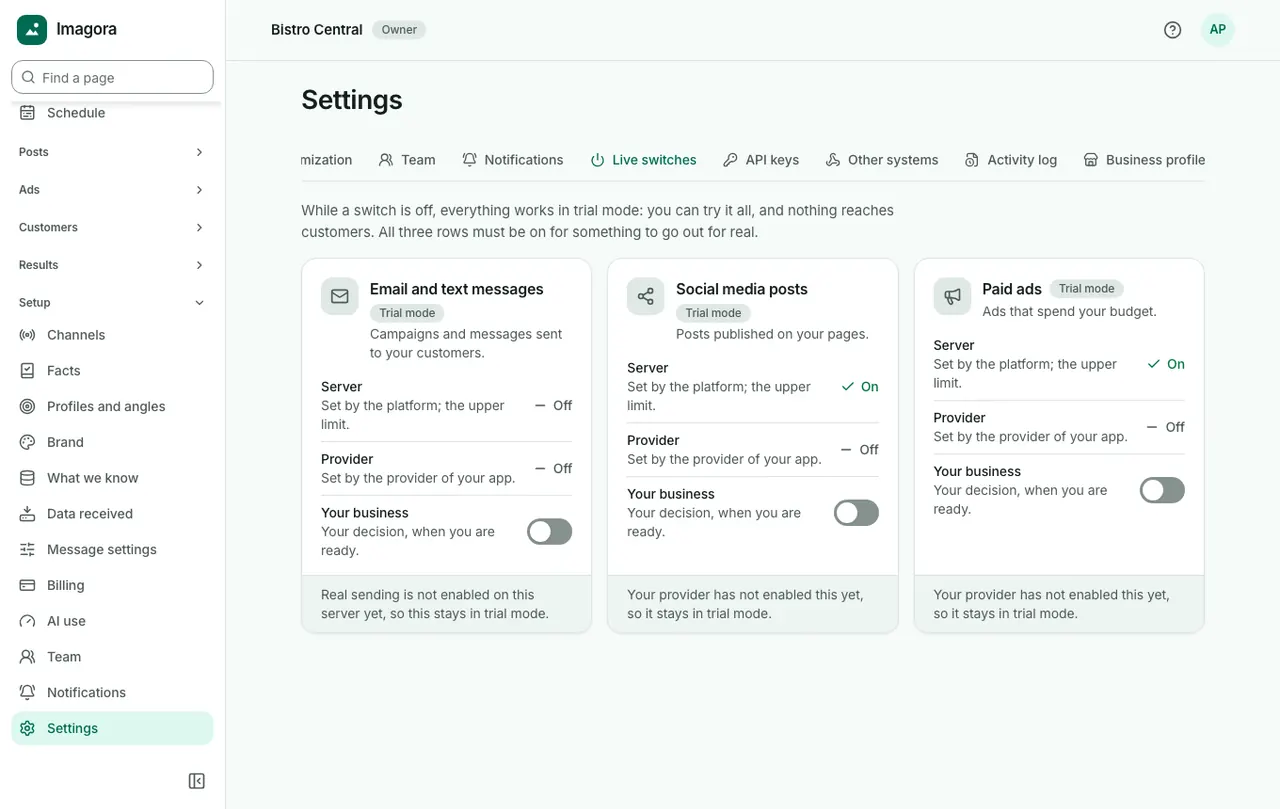
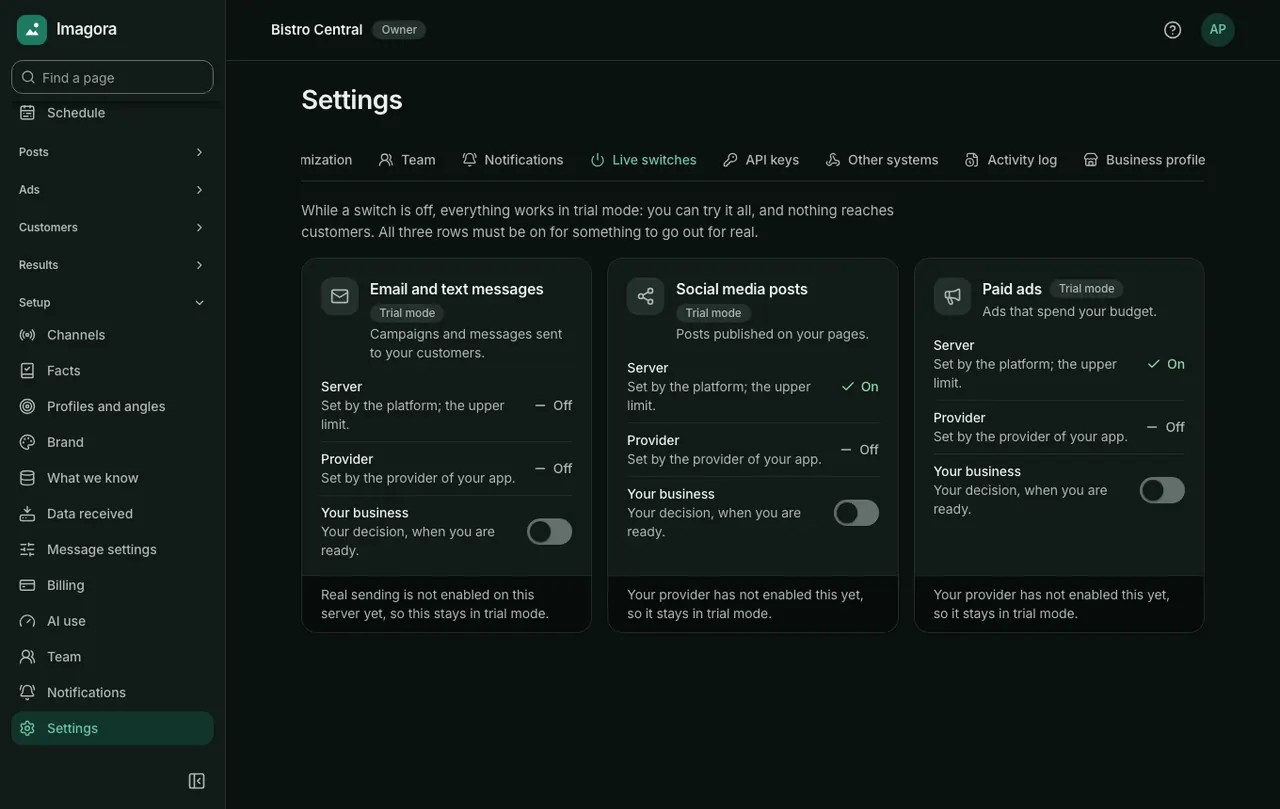
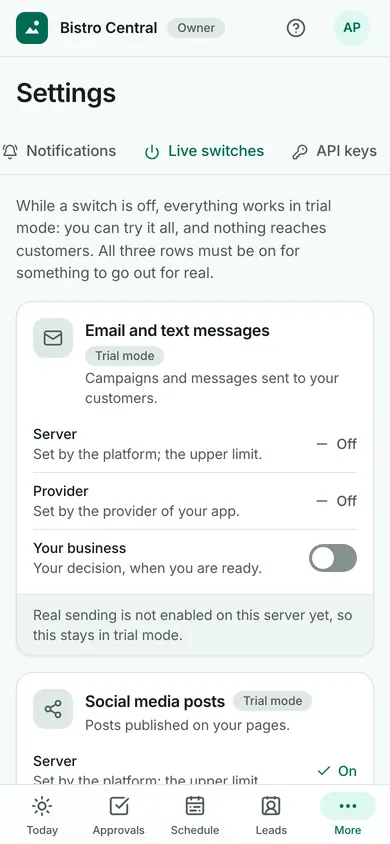
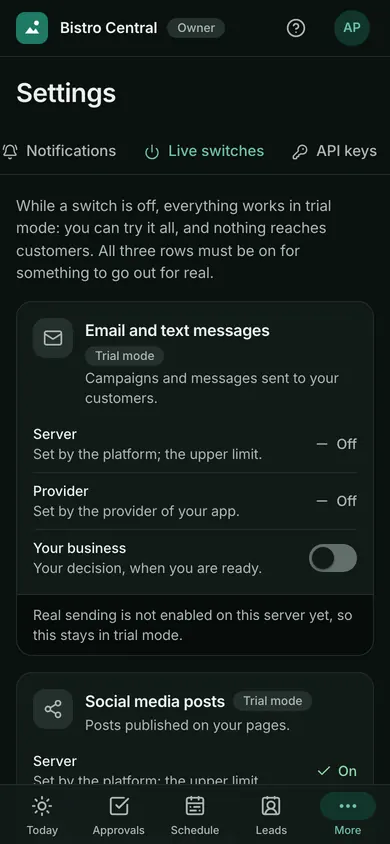
Messages, social posts and ads each have a live switch, and ads have an emergency stop. A post already published can be withdrawn.
Can I cancel?
Yes. The subscription is monthly and you manage it in the Stripe customer portal.
Tell us what you run.
How many locations, which trade, what you use today. We write back by email with the price for your case and what connecting would take.